

In 2024, 37% of Idaho households were living
below the ALICE Threshold.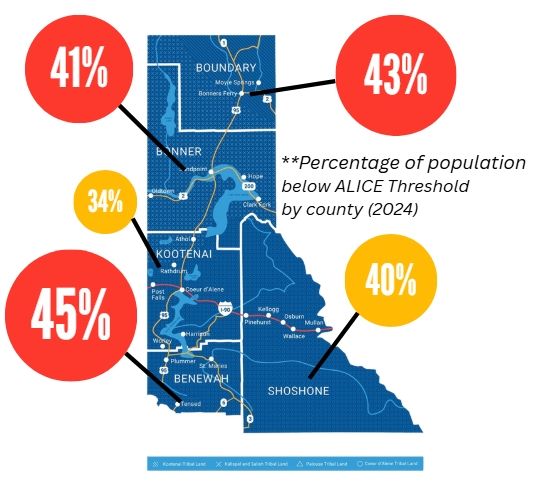
At United Way of North Idaho, we believe that good decisions begin with good data. That's why we use information from United For ALICE to better understand the financial realities facing individuals and families throughout our communities.
ALICE stands for Asset Limited, Income Constrained, Employed. ALICE households earn more than the Federal Poverty Level but less than what it actually costs to afford the essentials in their local communities. These families often work one or more jobs and contribute to the local economy every day, yet they continue to struggle to pay for housing, childcare, food, transportation, health care, and other basic necessities.
The latest ALICE Report for Idaho paints a clear picture of this challenge. In 2024, 37% of Idaho households were living below the ALICE Threshold, the minimum income needed to afford a basic household survival budget. Of those households, 11% lived below the Federal Poverty Level, while an additional 26% were ALICE—earning too much to qualify for many public assistance programs but not enough to achieve financial stability.
These numbers reveal an important truth: poverty statistics alone do not tell the whole story. For every household officially living in poverty, there are many more who are working hard yet remain financially vulnerable. A single unexpected expense — such as a car repair, medical bill, or reduction in work hours — can quickly push an ALICE family into crisis.
The ALICE data also shows that financial hardship affects households across every age, race, ethnicity, and family structure. While some groups experience disproportionately high rates of hardship, ALICE is not limited to one demographic. Seniors living on fixed incomes, young adults beginning their careers, families with children, and essential workers all face rising costs that often outpace wages.
Many of the people who make our communities function every day are ALICE. They are childcare providers, teachers, nursing assistants, retail associates, food service workers, mechanics, first responders, and countless others. They work hard, pay taxes, and contribute to the local economy, yet many still struggle to afford the basics.
The ALICE Threshold is also a more realistic measure of financial hardship than the Federal Poverty Level because it reflects the actual cost of living in local communities. It accounts for everyday expenses—including housing, child care, food, transportation, health care, and technology—providing a clearer picture of what families truly need to make ends meet.
At United Way of North Idaho, ALICE data helps inform everything we do. It guides our investments in programs that support financial stability, early childhood education, and health. It helps us identify gaps in services, collaborate with community partners, and advocate for policies that address the root causes of financial hardship. Most importantly, it reminds us that behind every statistic is a neighbor, coworker, friend, or family member working hard to build a better future.